More than Just Oil and Water: The Microbial Challenge in Production Separators
19 May 2026
How separator operating conditions drive microbial growth and corrosion risk.
In oil and gas operations, production separators are critical for maintaining hydrocarbon quality and ensuring efficient downstream processing. Yet, the same operating conditions that enable effective phase separation also promotes microbial growth, making these systems a significant risk point for microbiologically influenced corrosion (MIC).
As described in our previous blog 'The Hidden War Inside Your Risers: Microbes, Corrosion, and Production Risk' fluids produced from a reservoir do not emerge as pure oil. Instead, they form a multiphase mixture typically composed of crude oil, natural gas, produced water, and small amounts of solids. Before these resources can be safely processed, transported, or sold, they must first be separated into their individual components. Each of these phases behave differently and has its own handling requirements. To manage this, separation systems are designed to take advantage of the fluids’ natural physical differences—such as density, phase, and solubility. In practice, this is achieved through a series of separation vessels, where the mixture is gradually broken down in stages, allowing each component to be removed efficiently.
Operational Conditions That Enable Microbial Growth
Even though Separators are designed for hydrocarbon processing, they can unintentionally create conditions where microorganisms thrive, particularly in the water phase. A separator is essentially a settling tank designed to split the mixture into the different phases: Gas (rising to the top), water (sinking to the bottom) and oil (floating in between) - see schematic.
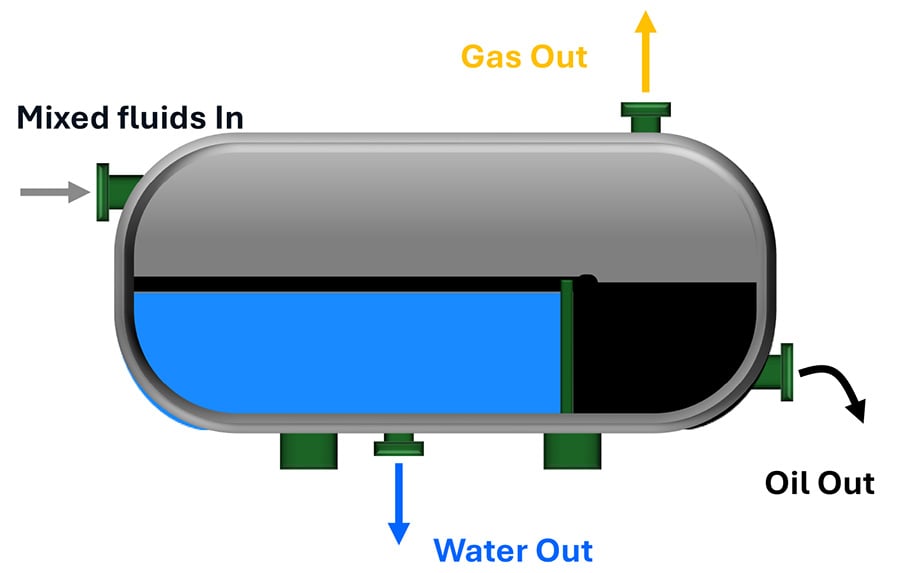
Separators can be classified based on their phase handling, either two phase systems of gas-oil or gas-water separation, or three-phase of gas, oil and water separation simultaneously. Their role extends beyond simple phase separation, ensuring efficient and uninterrupted production throughout the lifecycle of an oil field by protecting downstream equipment and maintaining hydrocarbon quality.
However, these same operational conditions can unintentionally create environments ideal for microbial proliferation. Several conditions in the separator promote microbial growth: moderate temperatures (20–80°C) provide a favourable environment for common oilfield bacteria; the presence of produced water offers a medium for survival; nutrients from hydrocarbons supply food; and low-oxygen, anaerobic conditions favour sulphate-reducing and other bacteria. In addition, stagnant areas, sludge, and solids allow biofilms to form, while the oil–water interface serves as an active zone where nutrients and water meet. In essence, a separator can act as an accidental incubator—warm, wet, nutrient-rich, and largely oxygen-free—perfect for microbial life.
Common Operational Problems Linked to Microbes
As a result, of the above described conditions, the created environments significantly increase the risk of MIC, can lead to H2S production, built-up of solids (biofilm) with potential impacts on asset integrity, process efficiency, and downstream system contamination.
Microbial growth can also exacerbate common separator issues, including foaming, where gas becomes trapped in liquids and reduces separation efficiency; emulsions, in which oil and water mix so finely that they resist separation; and can affect product quality. Even small microbial populations can intensify these problems, leading to costly maintenance and operational downtime.
Sources and Pathway of Microbial Contamination
Microbial contamination within separators can originate from multiple sources Well fluids often carry microorganisms from the reservoir, as separators are positioned near the wellhead for first-stage separation these microorganisms can enter the production process. Recirculated water from drain systems or other internal flows can also serve as a significant contamination pathway, often representing the main route through which microorganisms are introduced and redistributed within the separators.
Even where material choice and internal coatings are applied to reduce MIC, separators can still act as reservoirs for microbial activity, especially in adjacent pipes and bridles. Established communities within deposits or stagnant zones can persists and continuously seed the system, leading to downstream contamination and sustained corrosion risk.
From Risk to Control: Managing MIC in Separators
Given the range of risks outlined above, it is essential to implement a robust management strategy for production separators. Several approaches can be used to control microbial growth. Chemical treatments, such as biocides, help limit bacterial colonisation, while operational practices—including managing temperature, flow conditions, and effective water removal—reduce the likelihood of microbial activity. In addition, routine monitoring through microbiological testing and corrosion sensors enables early detection of potential issues. The overall aim is to maintain clean, efficient separation while protecting both equipment integrity and product quality.
Additionally, particular attention should also be given to identifying and managing sources of microbial contamination, such as drain systems. Addressing these pathways allows operators to move from reactive mitigation to a more proactive approach in controlling microbiologically influenced corrosion (MIC).
Our team can support the development of tailored monitoring programmes and assist with the collection and testing of oilfield samples to enable more informed, data-drive decision.
Get informed
Boost your own knowledge in oilfield microbiology with our two-day Oilfield Microbiology course on in Aberdeen, UK. Contact us to enquire about dates.