From start to finish, our Building Enclosure Commissioning (BECx) expertise ensures the success and long-term resilience of your construction project.
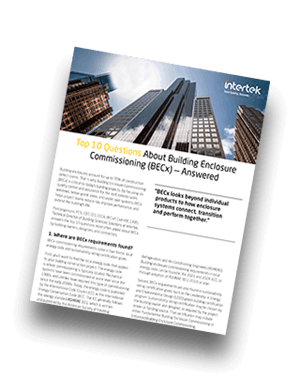
While a certain level of Building Enclosure Commissioning is often required by building codes or necessary for LEED v4/v4.1 certification, a comprehensive BECx strategy is critical to meeting specific building performance goals. From the Pre-Design Phase through Occupancy and Operations, we provide customized quality assurance (QA) and quality control (QC) processes for everything from simple structures to complex, multi-building campuses.
Today’s designs utilize evolving construction materials and challenging installation techniques. Intertek’s design and construction professionals provide a full range of BECx services globally, adhering to industry-leading standards such as ASTM E2813 and NIBS Guideline 3. Additionally, we complement the BECx process with our unique testing capabilities for subsurface utilities, acoustics, structural integrity, whole building airtightness, and energy performance.
Comprehensive BECx Services & Lifecycle Activities
We customize our BECx activities to ensure your building project exceeds performance expectations at every stage:
Pre-Design Phase: Setting the Foundation
- Owner’s Project Requirements (OPR): Work with the Building Owner to develop the OPR, defining performance targets for air, water, and energy.
- BECx Plan Development: Create a Building Enclosure Commissioning Plan with input from the design team.
- Concept Evaluation: Analyze design concepts against the OPR and the Architect-of-Record's intent.
- Project Management Setup: Identify online tools to track field issues and resolutions throughout the project lifecycle.
Design Phase: Ensuring Technical Compliance
- Basis of Design (BOD) Review: Evaluate the BOD prepared by the design team for alignment with performance goals.
- Technical Specifications: Develop BECx specification sections covering submittal reviews, mockups, field testing, and training.
- Design Reviews: Perform detailed reviews of drawings and specifications at multiple completion milestones.
- Advanced Modeling: Conduct hygrothermal analysis (WUFI) and thermal simulations (THERM) to prevent condensation and thermal bridging.
- Specialized Testing: Perform underground surveys of existing utilities and construction material testing for alternative systems.
Preconstruction Phase: Mitigating Risk Early
- Submittal & Shop Drawing Evaluation: Detailed review of enclosure components before they arrive on-site.
- Preconstruction Meetings: Coordinate with contractors to review schedules, critical details, and field-testing sequences.
- Mockup Observation: Witness mockup construction and perform initial building envelope performance testing to identify potential issues before full-scale installation.
Construction Phase: Performance Verification
- Site Inspections: Perform periodic site visits using construction checklists to verify enclosure system installation.
- Field Testing Coordination: Witness and coordinate critical tests for air leakage, water penetration, and structural integrity.
- Issue Tracking: Maintain a transparent issues and resolution log to ensure all enclosure deficiencies are closed out.
- Manual Preparation: Review project documents for the Operations and Maintenance (O&M) Manual and prepare the Building Enclosure Service Life Plan.
Occupancy and Operations Phase: Long-Term Reliability
- Facility Training: Conduct O&M training for personnel engaged in building operations.
- Warranty Review: Perform a 10-month warranty review and interview facility personnel to address any outstanding performance issues.
- Final Documentation: Compile and deliver the Final BECx Commissioning Report.
Common Questions About Building Envelope Commissioning (BECx)
Building enclosures account for up to 70% of construction defect claims. Implementing a structured BECx process helps project teams reduce risk, improve energy efficiency, and extend building life.
Pam Jergenson, FCSI, CDT, CCS, CCCA, BECxP, CxA+BE, CABS, Technical Director of Building Sciences Solutions at Intertek, answers the top questions asked by owners, designers, and contractors:
Building enclosure commissioning requirements typically stem from several sources: sustainability rating systems like LEED building commissioning requirements (v4/v4.1), state or local energy codes (such as IECC 2021 or ASHRAE 90.1), or specific Owner’s Project Requirements (OPR) focused on long-term durability and risk mitigation.
While traditional Cx focuses on active mechanical, electrical, and plumbing (MEP) systems, BECx services focus on the passive building "skin." Building enclosure commissioning ensures the roof, walls, and windows manage water, air, and heat transfer effectively, whereas Cx ensures the equipment inside those walls operates efficiently.
Yes, for high-performance buildings. A Cx consultant ensures the "lungs" (HVAC) of the building work, while a BECx consultant ensures the "lungs" aren't working overtime due to a leaky "skin." Most projects aiming for LEED building commissioning requirements will utilize both specialists to ensure a cohesive building envelope and mechanical strategy.
Absolutely. Intertek’s experts hold top industry credentials—including BECxP and CxA+BE—to ensure full compliance with ASTM E2813, the Standard Practice for Building Enclosure Commissioning. This certification guarantees that our building enclosure design review and field activities meet the highest technical standards.
Typically, the Mechanical Cx professional serves as the "Lead Commissioning Authority" (CxA) for administrative purposes, but the BECx professional manages all technical aspects of the enclosure. The two collaborate closely, particularly during whole building airtightness testing, where envelope integrity directly affects mechanical balancing.
The investment is justified through significant risk reduction; building enclosures account for roughly 70% of construction defect claims. By identifying issues during a building enclosure design review or through early building envelope testing services, owners avoid the astronomical costs of post-occupancy repairs, mold remediation, and energy waste.
Ideally, a consultant should be hired during the Pre-Design Phase. Early involvement allows for the greatest impact on the building enclosure design review, ensuring that high-performance details are "baked into" the drawings rather than added as expensive change orders later.
The process is a structured lifecycle of quality assurance. It begins with defining the OPR, moves into a technical building enclosure design review, transitions to building envelope testing services on-site (such as mockups), and concludes with whole building airtightness testing to verify the finished product meets the original performance goals.
No. A BECx consultant performs strategic site visits at "critical milestones"—such as the start of window installations or roof transitions. We provide targeted building envelope testing services at these junues to verify that the installation quality matches the approved building enclosure design review documents.
Training focuses on the "care and feeding" of the building skin. This includes reviewing the Building Enclosure Service Life Plan, identifying maintenance triggers for sealants and gaskets, and understanding how the results of the whole building airtightness testing impact the building's overall HVAC performance and energy goals.
Building Enclosure Commissioning (BECx) is a data-driven, quality-oriented process used to verify that a building's exterior—including the roof, walls, windows, and foundations designed and constructed to meet specific performance requirements.
While traditional commissioning focuses on "active" systems like HVAC and electricity, BECx focuses on the "passive" systems that protect the building from the elements. The process involves a rigorous lifecycle of activities, including technical design reviews, onsite inspections, and performance testing to ensure the enclosure effectively manages:
- Water Penetration: Preventing leaks that lead to structural rot and mold.
- Air Leakage: Minimizing uncontrolled air infiltration to reduce energy costs.
- Heat Transfer: Ensuring insulation and thermal barriers are continuous.
- Vapor & Moisture: Managing condensation risk within wall assemblies.
Deliver a Better Building. BECx strengthens project outcomes by reducing risk and supporting long-term building resilience. With certified expertise and a structured process, Intertek helps you deliver enclosures that perform as intended.
Related Links

23 Dec 2025
Designing and Verifying Water Control Strategies for Steep-Slope Gutters
How Analysis and Testing Improved Roof Drainage Performance at the Mann Center for the Performing Arts
02 Dec 2025
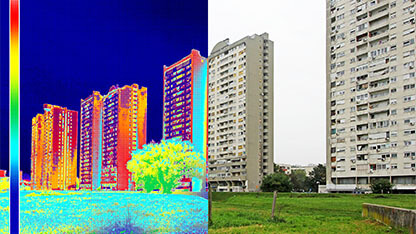
Understanding Building Enclosure Commissioning (BECx)
How BECx improves building performance, reliability, and long-term value
Featured on #YoullBeAmazed
See this post on LinkedIn or learn more about our You'll Be Amazed campaign.
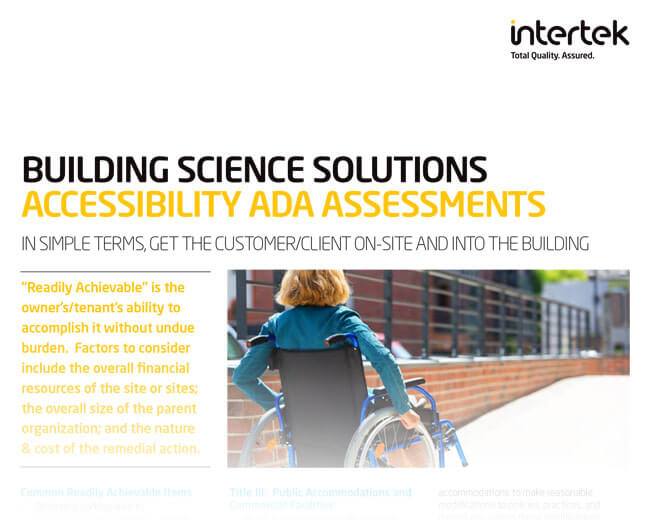
Accessibility ADA Assessments
Intertek's consulting services offer Accessibility ADA Assessments that focus on Title II and Title III, which are related to built conditions. Download our complimentary fact sheet to learn more.
Knowledge Center
Building Health & Wellness: An Overview of Services
Acoustical Testing & Consulting Resources
Remote Pre Inspections for NFPA 80 / 101
Protek - Safety. Everywhere. Every Day
Fire Doors 101: Your Guide to Testing and Certification - Webinar Recording
Tornado Testing & Certification Requirements - Webinar Recording
Plumbing Products Testing & Certification - Webinar Recording
The Evolving Code Evaluation Process White Paper
Proposition 65 & the Furniture Industry Webinar Recording
Why Planning for FCC Certification is Key to Success in the Door Hardware Industry White Paper

Upcoming Tradeshows & Events
Resources